Two New Studies Show How AI Can Help Make Emergency Care Safer and More Human
Emergency departments are the front door of the health care system. Every day, ED teams are asked to recognize serious illness, identify unmet needs, catch diagnostic risk, and make high-stakes decisions for patients they may be meeting for the first time. That work is essential, but the scale is enormous. Two new studies from members of our AI Division point to a common idea: AI may be most useful in emergency care when it helps clinicians notice what is otherwise too easy to miss.
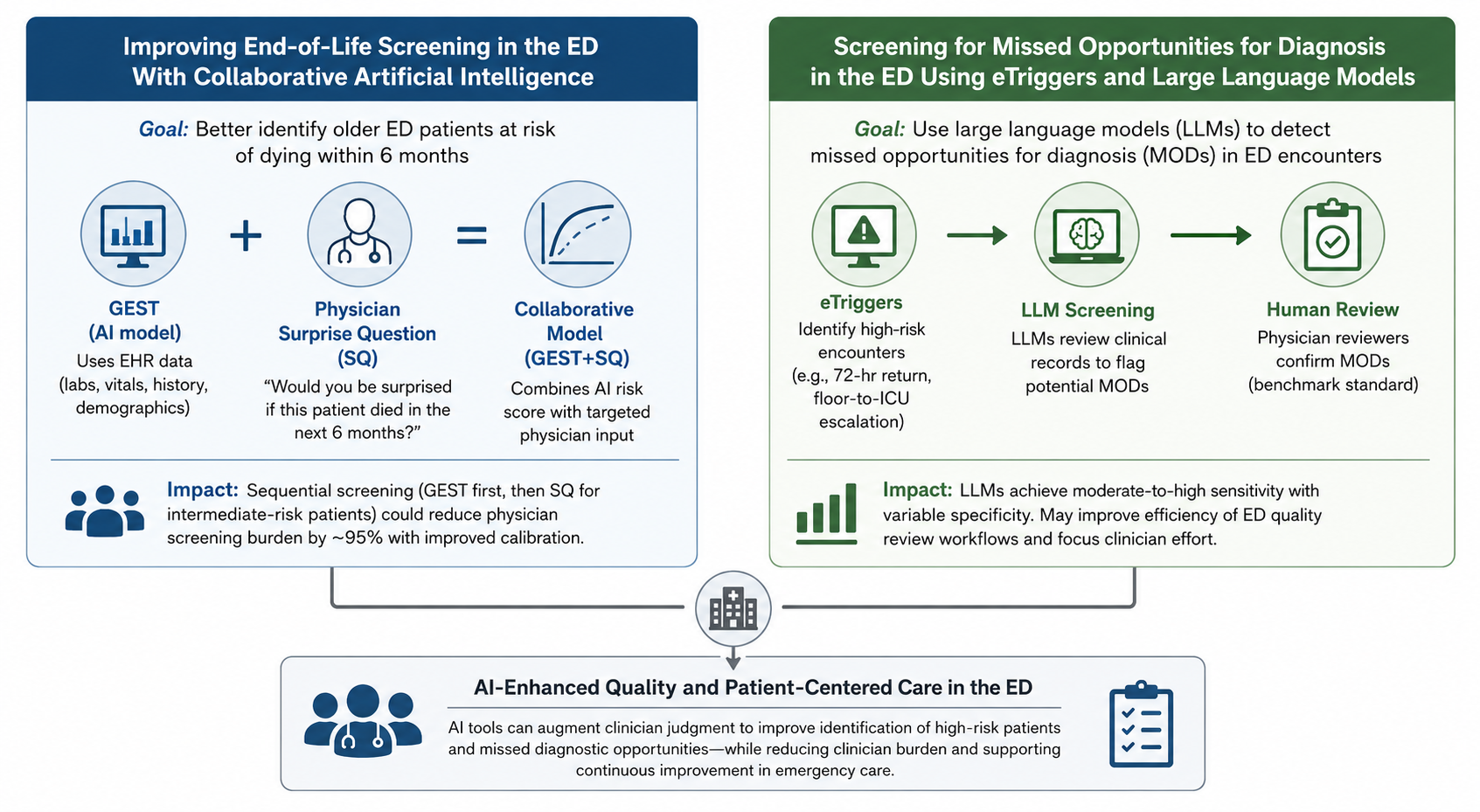
In Annals of Emergency Medicine, Adrian D. Haimovich, Gabriel Erion-Barner, Larry A. Nathanson, Caroline Cohen, Roger Orcutt, Smit Desai, David Rubins, Ula Hwang, Richard Andrew Taylor, Nathan I. Shapiro, Kei Ouchi, and Mara A. Schonberg published “Improving End-of-Life Screening in the Emergency Department With Collaborative Artificial Intelligence.” The study takes on one of the central challenges in emergency medicine: identifying patients with serious illness and possible end-of-life care needs during a busy ED visit.
Many patients with life-limiting illness come through the ED, often at moments of crisis. For some, the visit may be an opportunity to clarify goals, align care with patient values, or connect patients and families with palliative care support. But emergency clinicians are already managing crowding, boarding, diagnostic uncertainty, acute resuscitation, and the needs of many other patients at the same time. The study explores how AI-supported screening can help shoulder part of that cognitive and operational burden. The goal is not to replace clinical judgment, but to make it easier for clinicians to identify the patients who may benefit from a more human conversation. View Article
A second study, published in JAMA Network Open, focuses on another core ED responsibility: diagnostic quality. Clifford M. Marks, Sean Gibney, Bryan Stenson, Deesha Sarma, Cynthia Gaudet, Haadi Mombini, Thomas A. Buckley, Mario Keko, Larry A. Nathanson, Laura G. Burke, Nathan I. Shapiro, Jonathan L. Burstein, Shamai A. Grossman, Anika Parab, Alexander T. Janke, Arjun K. Manrai, Richard A. Taylor, Carlo L. Rosen, Adam Rodman, and Adrian D. Haimovich published “Screening for Missed Opportunities for Diagnosis in the ED Using eTriggers and Large Language Models.”
The best emergency departments are learning systems. They review cases, look for patterns, and use diagnostic misses or near-misses to improve future care. But this kind of review is hard to scale. It often depends on small groups of clinicians with limited time, especially in community hospitals and smaller EDs that may not have the staffing or infrastructure to support continuous diagnostic quality improvement.
In this study, the team evaluated whether large language models could augment chart review for missed opportunities for diagnosis. The work used ED electronic trigger cohorts, including return admissions within 72 hours and floor-to-ICU transfers within 24 hours, and compared several commercial LLMs against physician-adjudicated case reviews. The findings show both promise and caution: LLMs may help expand diagnostic quality review, but their behavior varies across models and clinical contexts. Implementation will require careful evaluation inside the actual review workflow. View Article
Together, these papers reflect the same broader vision for AI in emergency medicine. AI should not make emergency care less personal. Used well, it can help clinicians find the patients who need more attention, more reflection, or a different kind of conversation. It can support the work that matters but is difficult to sustain at scale: recognizing serious illness, learning from diagnostic risk, and building ED systems that are safer, more reliable, and more human.